
Workspaces
A workspace is one line of work inside a project: a git branch, checked out in its own folder (a git worktree), with the terminals running in it. Because each workspace has its own folder, agents working in parallel never step on each other — or on you.
Workspaces are plain git. Everything Yardsort does you can inspect with git worktree list and
git branch, and nothing stops you using those folders from any other tool.
Starting one: the composer
Press + on a project row, or Ctrl+Shift+N / ⌘N for the project you are in.
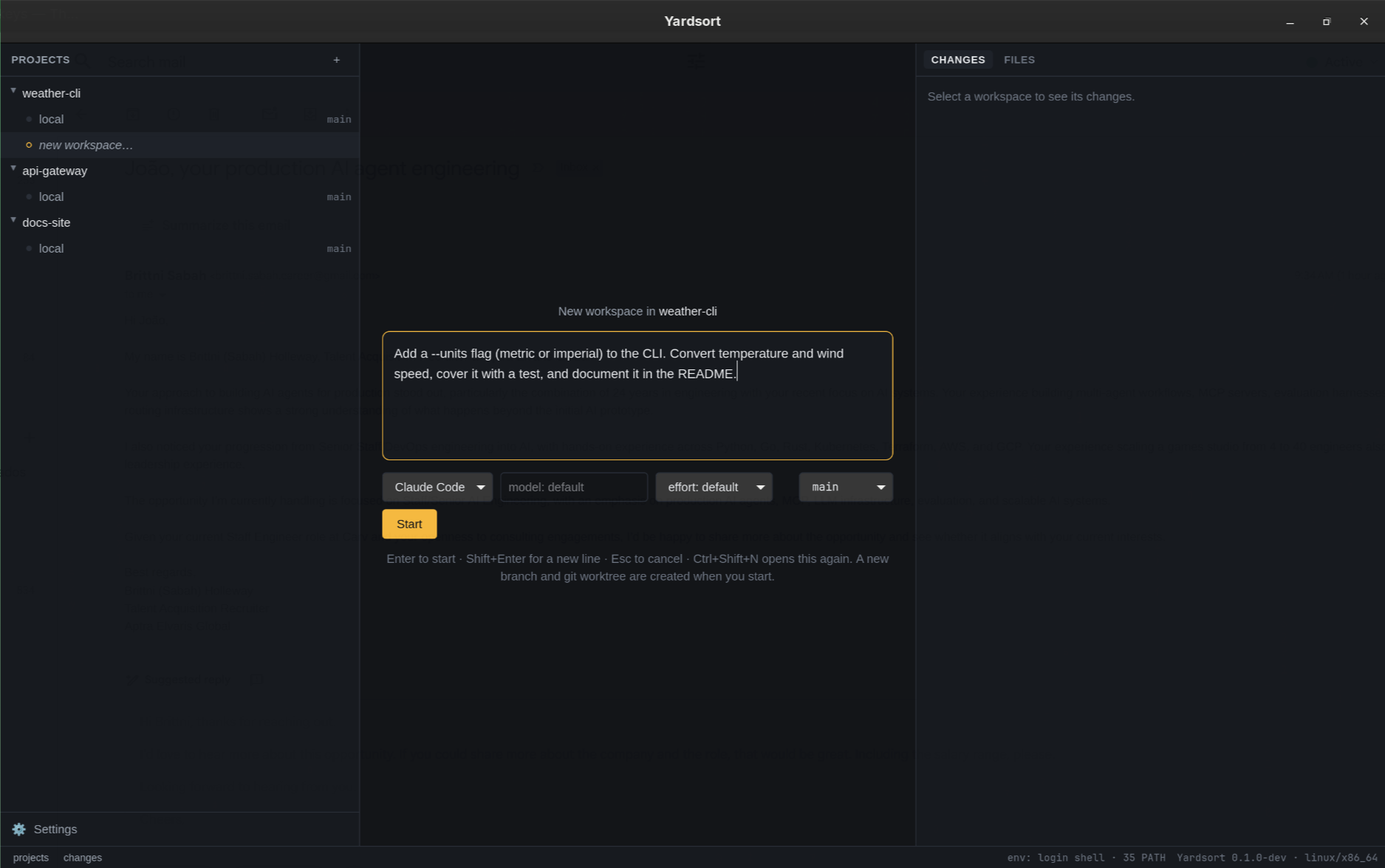
| Field | What it does |
|---|---|
| Message | The agent's first prompt. Enter starts, Shift+Enter makes a new line. Leave it empty to just open the agent. |
| Harness | Which agent to run. The list comes from settings. |
| Model | Free text with suggestions. Empty means "let the agent use its default" — no flag is passed at all. |
| Effort | Offered only for agents that have the concept. |
| Branch | Under New branch from, pick the branch to start from. Under Open existing branch, pick a branch to check out in a workspace as it is — no new branch is made. |
Your last choices are remembered per project. Nothing is created until you press Start —
cancelling (Esc) leaves no trace.
On Start, Yardsort:
- names the workspace from your message (
Add a --units flag…→add-units-flag), making it unique if needed; - runs
git worktree addwith a new branch,ys/add-units-flagby default; - starts the agent there with your message.
If the agent cannot be started — not installed, say — the worktree and the new branch are taken back, so a failed attempt leaves nothing behind. A branch that existed before is never deleted.
Where the folders go
~/yardsort/<project>/<workspace> by default. Change the folder and the ys/ branch prefix in
Settings → Workspaces. Changing them affects new workspaces only.
Files git does not track
A fresh worktree contains what is committed — so .env files, node_modules and other ignored
or untracked things are not there. Ask the agent to install dependencies, or copy what you
need in a shell tab.
Worktrees made elsewhere
Worktrees you created by hand, or with another tool, show up as workspaces automatically the next time the project is listed. Nothing is moved or changed; Yardsort just learns about them.
The workspace menu
Hover a workspace and press ⋯, or right-click it.
Rename…
Changes the label only. The folder and the branch keep their names on purpose: agents file their conversations by folder, so moving it would orphan them — and would pull the rug from under anything running there.
Archive…
For work you are done with for now. The folder is removed from disk; the branch, its commits and the session history are kept. The workspace moves to a collapsed archived (n) group at the bottom of its project.
Restore workspace, from the archived entry's menu, checks the branch out again at the same path — which is what makes its old conversations resumable.
Delete workspace…
Removes the folder and forgets the workspace. The branch is always kept — deleting a workspace never throws away commits. Delete the branch yourself with git if you want it gone.
Uncommitted work is protected
Archiving and deleting both remove a folder, and uncommitted changes live only there. If there are any, Yardsort stops and asks again, saying plainly that the work will be lost for good. Nothing is destroyed on the first click.
When a workspace's folder disappears
If the folder is deleted behind Yardsort's back, the workspace is marked missing. Its menu offers Restore from its branch (check it out again in the same place) or Delete.