
Terminals & sessions
The middle of the window is a real terminal. Agents run in it exactly as they do anywhere else — Yardsort does not re-implement their interface or read their output.
Tabs
Each workspace has its own row of tabs.
- The agent buttons on the right of the tab bar start that agent in this workspace, with no prompt. (To start one with a prompt and a fresh branch, use the composer.)
- + or
Ctrl+Shift+T/⌘Topens a shell in the workspace folder — for running tests, a dev server, or git by hand, next to the agent. - × or
Ctrl+Shift+W/⌘Wcloses a tab and stops what runs in it.
Clicking a workspace that has nothing running — and no earlier conversations — opens a shell there, so choosing a workspace always lands you somewhere useful.
Terminals keep running when you look elsewhere. Switch workspaces or tabs freely; when you come back the screen is repainted exactly as it was, scrollback included.
Copy, paste, links
| Linux / Windows | macOS | |
|---|---|---|
| Copy the selection | Ctrl+Shift+C | ⌘C |
| Paste | Ctrl+Shift+V | ⌘V |
| Open a link | Ctrl+click | ⌘+click |
Plain Ctrl+C, Ctrl+V and a plain click belong to the program in the terminal. See
Keyboard shortcuts for why.
Status dots
The dot on a tab, and the one on each workspace in the sidebar, tell you what is going on without opening anything:
| Dot | Meaning |
|---|---|
| pulsing | printing right now — an agent at work |
| solid | running but quiet for a few seconds — most likely waiting for you |
| ringed | an agent finished a long stretch of work that you have not looked at yet |
| grey | nothing running |
| red (tabs) | the program exited with an error |
This comes purely from terminal activity. Agents animate a spinner while they think, so for them silence really does mean "your turn".
Notifications
When an agent has been busy for a while (eight seconds or more), goes quiet, and Yardsort is not the window you are looking at, you get a desktop notification: "claude is waiting — project / workspace". Shells never notify, and neither does anything you are watching.
Turn it off in Settings → General.
Sessions: resume and fork
Agents save their conversations on disk. Yardsort keeps a record of each one — which agent, which conversation, your first message as its title — so you can return to it after the process is gone: because you closed the tab, the agent exited, or you quit Yardsort.
Resume
Same conversation, new process.
- A workspace with nothing running lists its previous sessions. Press Resume on one.
- A tab whose agent has ended shows a bar with Resume; the dead terminal is replaced.
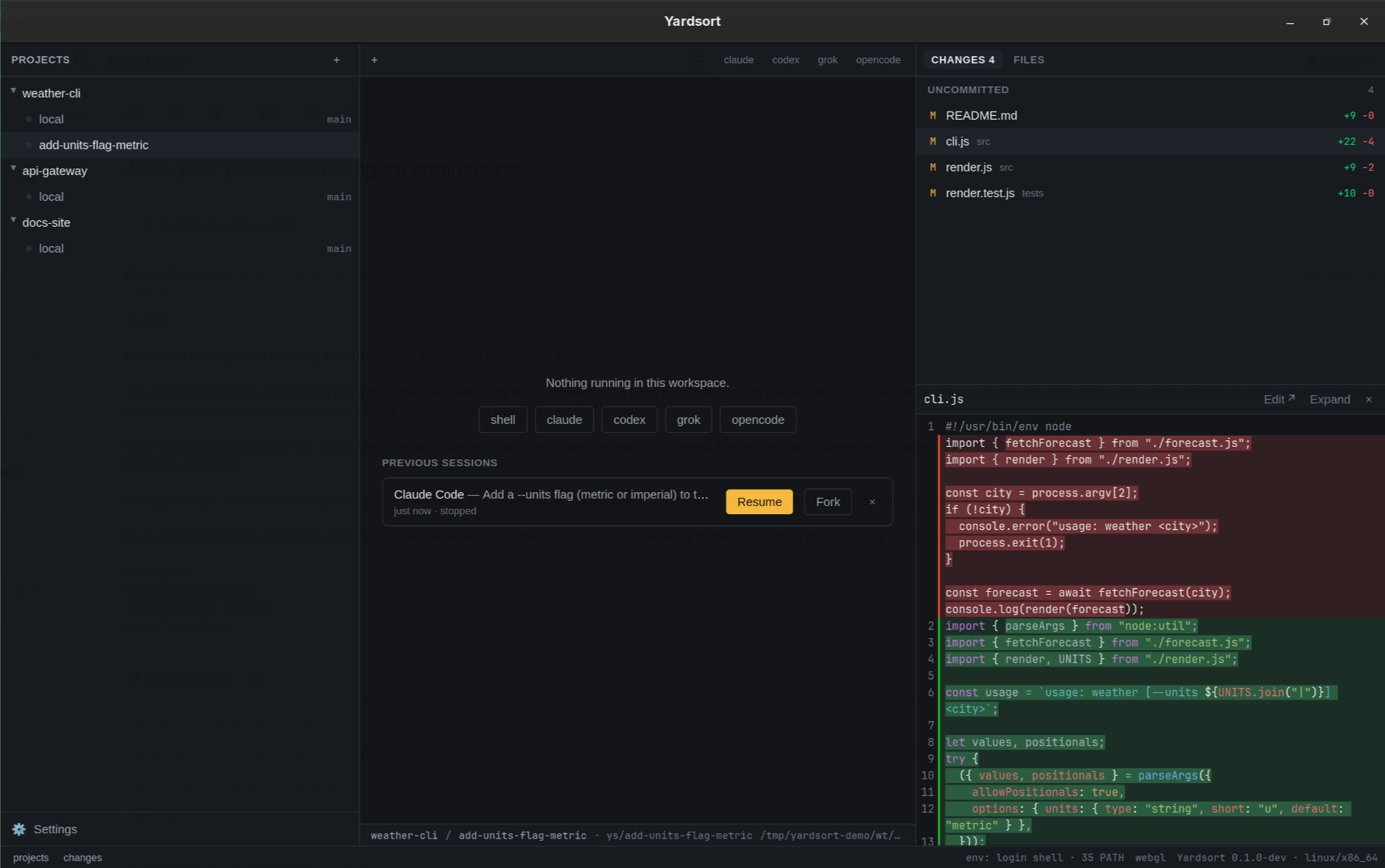
After restarting Yardsort nothing is started for you — you choose what to bring back. Sessions that were running when Yardsort closed are labelled interrupted; they resume like any other.
Fork
A copy of the conversation that goes its own way, in a new tab. The original is untouched. Use it to try a different approach without losing the first. You can fork an ended session from the list or the bar, and a running one by right-clicking its tab.
Forget
× on a previous session removes it from Yardsort's list. The agent's own saved conversation is not touched.
What can be resumed
| Agent | Resume / fork |
|---|---|
| Claude Code, Grok | Any recorded session. Yardsort chooses the conversation's id up front, so it can always name it. |
| Codex, OpenCode | The most recent conversation in the workspace. These agents choose their own ids, and "continue the latest one here" is the only handle they offer. Older entries say so rather than offering a button that would open the wrong conversation. |
If a session cannot be continued — its agent was disabled or removed in settings, for example — the list says why.