
Settings & harnesses
Open with the Settings button at the bottom of the left panel, or Ctrl+Shift+, / ⌘,.
Settings are stored in a plain TOML file you can read, back up and edit:
| System | Location |
|---|---|
| Linux | ~/.config/dev.yardsort.app/settings.toml |
| macOS | ~/Library/Application Support/dev.yardsort.app/settings.toml |
| Windows | %APPDATA%\dev.yardsort.app\settings.toml |
If the file cannot be parsed, Yardsort says so, runs on defaults, and keeps your file as
settings.toml.unreadable instead of overwriting it.
Harnesses
A harness is a coding agent that runs in a terminal. To Yardsort a harness is pure configuration — a command and some argument templates — so any agent can be added without waiting for a new release.
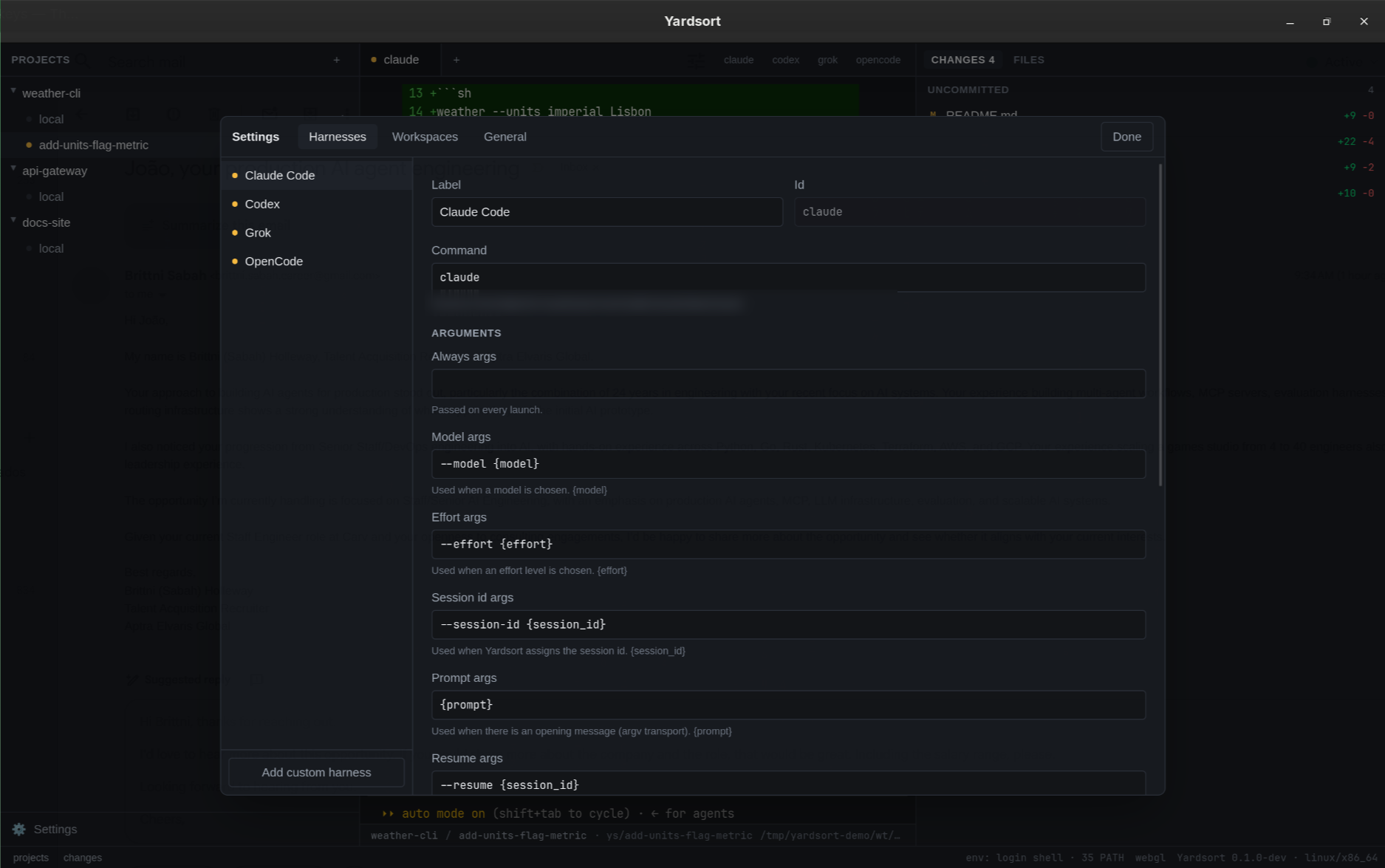
Built in: Claude Code, Codex, Grok, OpenCode. The dot next to each shows whether
its command was found on your PATH.
Fields
| Field | Meaning |
|---|---|
| Label | The name shown in the app. |
| Command | The program to run. It is looked up on the PATH of your login shell (so tools installed by mise, nvm, Homebrew or cargo are found), and the resolved location is shown underneath. |
| Always args | Passed on every launch — the place for flags you always want, such as a permission mode. |
| Model args | Used when a model is chosen, e.g. --model {model}. |
| Effort args | Used when an effort level is chosen, e.g. --effort {effort}. |
| Session id args | Used when Yardsort assigns the conversation's id, e.g. --session-id {session_id}. |
| Prompt args | How the first message is passed, e.g. {prompt} or --prompt {prompt}. |
| Resume args | Replaces the last two groups to continue a conversation, e.g. --resume {session_id}. |
| Fork args | Same, to fork one, e.g. --resume {session_id} --fork-session --session-id {new_session_id}. |
| Models / Efforts | Suggestions for the composer's pickers. Models accept free text regardless. Leave efforts empty to hide that picker. |
| Prompt transport | argv passes the prompt as an argument — simple and reliable. stdin starts the agent first and pastes the prompt once it has been quiet for the given time — for agents with no prompt argument. Very long prompts switch to stdin automatically. |
| Session id | assigned: Yardsort chooses the id, so any session can be resumed. latest in folder: the agent chooses, and only its most recent conversation in a workspace can be continued. |
| Enabled | Disabled harnesses stay configured but are not offered. |
How arguments work
- Arguments are split like a shell would split them (quotes group words), but no shell is involved. Each argument reaches the program exactly as written, and a placeholder's value is never split again — a prompt full of quotes, spaces and newlines is still one argument.
- Placeholders:
{prompt}{model}{effort}{session_id}{new_session_id}. - A group whose placeholder has no value is dropped whole: choose no model and no dangling
--modelis passed.
What will run at the bottom shows the exact command lines — start, resume and fork — for sample values, updating as you type. Test launch starts the harness, unsaved changes included, in a scratch terminal so you can see it come up.
Restoring defaults
For a built-in harness only your changes are saved, so improved defaults in a newer Yardsort still reach every field you left alone. Restore defaults discards your changes.
Adding your own harness
Add custom harness, give it an id, and fill in at least the command. If the agent can take a first message, set Prompt args (or the stdin transport); fill Resume args / Fork args if it can continue conversations. Custom harnesses appear in the composer and the tab bar like the built-in ones. Delete removes one.
Workspaces
| Setting | Meaning |
|---|---|
| Worktree folder | New workspaces are created in <folder>/<project>/<workspace>. Default: ~/yardsort. Must be an absolute path; keep it short on Windows, where deep paths hit the 260-character limit. |
| Branch prefix | New branches are named <prefix>/<workspace>. Default ys. Empty means no prefix. |
Both apply to workspaces created from now on; existing ones stay where they are.
General
| Setting | Meaning |
|---|---|
| Editor command | What Edit ↗ runs — code, cursor, zed, … It is given the workspace folder and then the file. Empty tries cursor, code, zed, windsurf, subl and idea in turn. |
| Check for updates automatically | Looks for a newer release shortly after starting and once a day. On by default. Check now looks immediately and shows the version you are running. See Updates. |
| Notify me when an agent finishes | Desktop notifications when a busy agent goes quiet while you are in another window. On by default. |
Environment variables
For testing and unusual setups:
| Variable | Effect |
|---|---|
YARDSORT_DATA_DIR | Keep the database and settings.toml in this folder — a throwaway profile. |
YARDSORT_WORKTREE_ROOT | Override the worktree folder. |